
















Mastering the Precision of Slice It
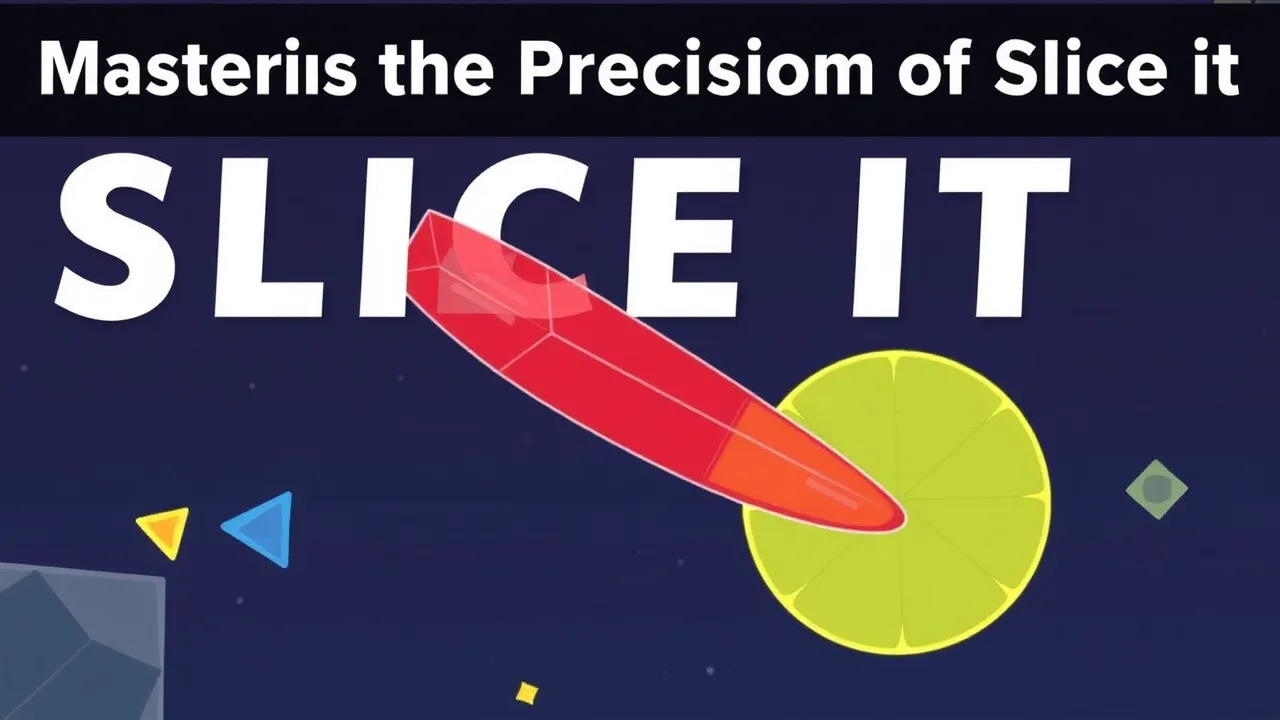
Welcome to your ultimate guide for Slice It, the physics-based puzzle game that tests your precision and spatial reasoning. If you are looking for a challenging yet satisfying experience where every cut counts, you have come to the right place. This page explores the mechanics, strategies, and unique appeal of this addictive title, helping you understand exactly what makes it such a compelling test of skill.
At its heart, this game is a geometry challenge wrapped in a physics engine. Your primary objective is deceptively simple: slice a complex shape into pieces that match a set of silhouettes. However, the shapes you are given are often asymmetrical and intricate, requiring you to calculate angles and trajectories carefully. Unlike casual cutters where you simply swipe across the screen aimlessly, every move here requires planning. You are given a limited number of cuts, usually indicated by markers, and you must use them efficiently. The satisfaction comes from watching your calculated slice fall perfectly into place, transforming a chaotic blob into an organized puzzle solution.
Why Precision Matters More Than Speed
In many puzzle games, speed is the driving factor. Here, however, patience is your greatest asset. Rushing through a level often leads to wasted cuts and misaligned pieces. The physics engine simulates gravity and friction, meaning that once you make a cut, the pieces will slide and settle. If you do not account for the shape of the floor or the way the pieces will interact, you might end up with a solution that looks close but fails the level. Mastering the game means learning to visualize the end result before you even make your first slice. It is a mental exercise in foresight that rewards careful thought over rapid reflexes.
Game Overview and Quick Reference
Before diving deeper into the mechanics, it helps to have a snapshot of what to expect. This table breaks down the essential elements of the gameplay experience, from the controls you will use to the pace of the challenges.
| Feature | Details |
|---|---|
| Gameplay Style | Physics-based geometry puzzle |
| Controls | Click and drag to draw cut lines |
| Session Pace | Relaxed and cerebral, no time limit |
| Device Fit | Optimized for both desktop and mobile play |
| Category Match | Ideal for logic and brain-teaser enthusiasts |
Understanding the Physics Engine
The game relies heavily on a realistic physics engine. When you slice an object, it does not just separate; it reacts. The weight of the pieces, the angle of the cut, and the surface they land on all play a role in the outcome. Sometimes, you need to slice a piece so that it slides down a slope and nudges another piece into position. Other times, you might need to create a wedge that stops a piece from falling off the platform. Learning how the objects interact with the environment is key to solving the harder levels. You are not just cutting shapes; you are manipulating a dynamic system where every action has a physical reaction.
Strategies for Solving Complex Shapes
As you progress, the shapes become more irregular and the target silhouettes more demanding. A good strategy is to start by identifying the largest pieces required for the silhouette. Try to make your first cuts to isolate these major chunks. Once the bulk of the shape is accounted for, you can use your remaining cuts to refine the smaller, more intricate details. Another helpful tip is to look at the negative space. Sometimes, focusing on what you need to remove is easier than focusing on what you need to keep. Visualizing the empty space between the silhouette pieces can guide your knife to the perfect starting point.
The Satisfaction of Perfect Alignment
There is a unique sense of accomplishment that comes with a perfect run. When you use the exact number of cuts required and the pieces slide perfectly into the target zones, it feels like a feat of engineering. The game often provides a star rating based on your efficiency, encouraging you to replay levels to find a better solution. This replayability adds depth to the experience. You might solve a level using three cuts, only to realize later that it could be done in two with a clever angle. This pursuit of the "perfect cut" keeps the gameplay loop engaging long after the initial challenge is overcome.
Brain Training and Mental Focus
Beyond entertainment, this title serves as a solid exercise for the brain. It engages your spatial awareness, requiring you to mentally rotate and deconstruct shapes before acting. This kind of thinking is beneficial for developing problem-solving skills. Because there is no timer ticking down, you can take as long as you need to analyze the problem, making it a great way to unwind while still keeping your mind active. It strikes a balance between relaxation and mental exertion, offering a stress-free environment where logic is the only tool you need.
Common Challenges and How to Overcome Them
Players often encounter a few common hurdles. One frequent issue is the "sliding problem," where a piece is cut correctly but slides away from the target due to momentum. To fix this, try making your cuts more vertical to minimize lateral movement. Another challenge is running out of cuts. If you find yourself stuck with one cut left and multiple pieces to fix, you likely made an unnecessary cut earlier. Reset the level and try to combine two smaller operations into one single, decisive slice. Patience is the antidote to frustration here; if a solution isn't working, step back and look at the shape from a fresh angle.
FAQ
Is this game suitable for children?
Yes, the game is very family-friendly. It contains no violence, inappropriate language, or complex narrative themes. It is purely a logic and physics puzzle, making it appropriate for players of all ages who enjoy brain teasers.
Do I need an internet connection to play?
Generally, once the game is loaded, it does not require a constant internet connection. However, some versions may need a connection for saving progress or loading ads if it is a free-to-play version. It is perfectly playable during a commute or in areas with spotty Wi-Fi.
How do I get a 3-star rating on a level?
The star rating is typically determined by the number of cuts you use. To get the maximum rating, you must solve the puzzle using the minimum number of cuts possible. This often requires finding the most efficient geometric solution rather than just any solution.
Are there different difficulty levels?
The game usually follows a linear progression. It starts with simple shapes and basic physics to teach you the mechanics. As you advance through the chapters or worlds, the shapes become more complex, the physics interactions more tricky, and the number of required cuts more restrictive.